CV vs Resume: What's the Difference and Which One Do You Need?
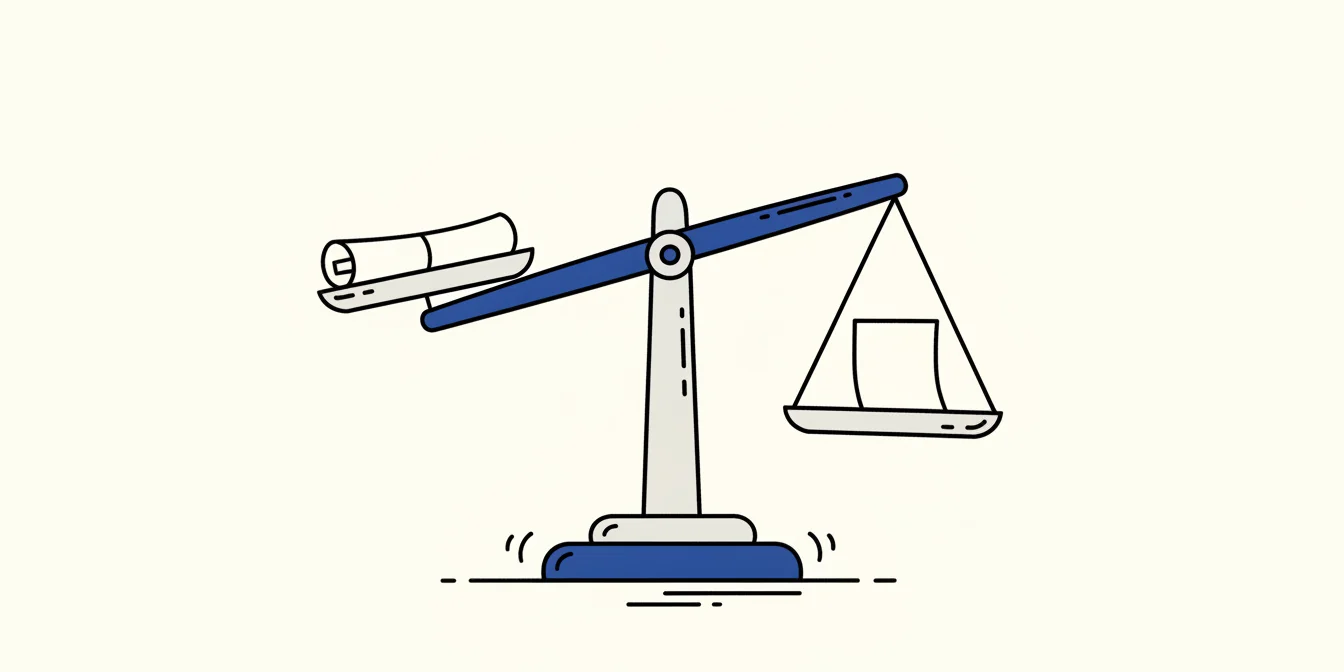
The CV vs resume question has a short answer and a useful answer. Short: a resume is a 1–2 page document tailored to one job; a CV (curriculum vitae — Latin for "course of life") is a comprehensive record of your whole career. Useful: which one you need depends almost entirely on where you're applying, because in most of the world "CV" simply means what Americans call a resume.
Getting this wrong has real costs — sending a five-page academic CV to a London startup, or a one-page American resume where a Europass format is explicitly required. This guide settles the difference, maps the regional expectations, and shows how to convert between the two.
CV vs resume: the core differences
| Resume | CV (academic sense) | |
|---|---|---|
| Length | 1–2 pages | No limit — grows with your career |
| Purpose | Marketing document for one specific job | Complete scholarly/professional record |
| Content | Relevant experience, skills, selected wins | Everything: publications, grants, teaching, talks |
| Tailoring | Rewritten per application | Mostly static; updated as career grows |
| Order | Reverse-chronological, most relevant first | Conventional academic section order |
| Used for | Business, nonprofit, government, tech jobs | Academia, research, medicine, fellowships |
The deeper difference is philosophy: a resume answers "why should you interview me for this role?" while a CV answers "what is the complete record of my work?" One is selective by design; the other is exhaustive by design.
CV vs resume by region: what each market expects
United States and Canada
"Resume" is the standard for virtually all jobs; 1–2 pages, no photo, no date of birth. "CV" specifically means the long academic document and is only requested in academia, research, and medicine.
UK and Ireland
Everyone says "CV," but they mean a short document — 2 pages is the norm. Don't send anything longer just because it's called a CV. No photo.
Continental Europe
"CV" again means the short document (1–2 pages), but conventions vary by country: photos and birth dates are still common in Germany and Austria, increasingly optional in the Nordics and Netherlands, and discouraged in anonymized-screening contexts. Our resume photo guide breaks down when to include one. For EU institutions, scholarships, and many internships, the standardized Europass CV format may be explicitly required — use it when asked, and a normal CV when not.
Australia and New Zealand
The terms are used interchangeably for the same 2–3 page document.
Academia, everywhere
The full curriculum vitae — complete publications, grants, teaching record — regardless of country. If you're unsure what a true academic CV contains, the term's history and structure are well covered on Wikipedia's curriculum vitae entry.
When you genuinely need the long-form CV
- Academic and research positions — faculty, postdocs, research institutes.
- Medicine — residency, fellowship, and many clinical applications.
- Grants, fellowships, and scholarships — funders want the full record.
- Some international and public-sector applications — where a complete history (sometimes in Europass form) is specified.
Everyone else — which is most people reading a CV-vs-resume comparison — needs the short, tailored document, whatever their country calls it.
How to convert a CV into a resume (and back)
CV → resume: subtract and target
- Keep the last 10–15 years of experience relevant to the target role; compress or cut the rest (how far back a resume should go covers the exceptions).
- Collapse publications, conferences, and teaching into a line or two — or drop them unless relevant.
- Add a 2–3 line professional summary aimed at the specific job — here's how to write the About Me section.
- Rewrite duties as quantified accomplishments ("supervised lab of 6, cut sample processing time 30%").
- Mirror the posting's language — the full method is in our guide to tailoring your resume to a job description.
Resume → CV: expand and complete
Re-add everything you trimmed: full positions list, publications, presentations, grants, certifications, professional memberships. Accuracy and completeness beat brevity here.
What CVs and resumes share in 2026: the ATS
Whether the file is called CV or resume, online applications in both the US and Europe almost always pass through an applicant tracking system first. The same survival rules apply to both documents:
- Single-column layout, standard headings, no text boxes or tables.
- Keywords mirrored from the job description — our job description keyword finder pulls them out for you.
- PDF unless the employer asks otherwise.
- Run it through a free ATS resume checker before submitting — it works for European-style CVs too.
- If the employer asks for the EU standard document, start from the Europass CV template and example rather than reformatting by hand.
Related resources
- Europass CV Format Guide — when the EU standard format is required and how to make it strong
- How to Tailor Your Resume to a Job Description — the per-application workflow
- Resume With or Without Photo — the regional photo rules
- ATS Resume Template — a clean base layout for either document
- Free ATS Resume Checker — verify parsing before you apply
Frequently Asked Questions
Are a CV and a resume the same thing?
It depends where you are. In the US and Canada they're two different documents: a resume is 1–2 pages and tailored to one job, while a CV is a long, complete academic record. In the UK, Ireland, and most of Europe, Asia, and Africa, "CV" is simply the everyday word for what Americans call a resume — and it's expected to be just as short. So: the same thing in most of the world, genuinely different things in North America.
What is the difference between a CV and a resume?
A resume is a short (1–2 page) marketing document tailored to one specific job; a CV (curriculum vitae) is a longer, comprehensive record of your career. In the US and Canada, resumes are standard and CVs are reserved for academia. In the UK, Ireland, and most of Europe, "CV" is simply the word for what Americans call a resume — and it's expected to stay short.
Should I use a CV or a resume to apply for a job?
Use whatever the employer's region calls its standard short document: a resume in the US and Canada, a 1–2 page CV in the UK and Europe, either term in Australia. The only time you need a long-form CV is for academic, research, medical, or some international/government roles where a full publication and career history is required.
Is a Europass CV the same as a regular CV?
No. Europass is a specific standardized CV template from the European Union with fixed sections and layout. It's commonly requested for EU institutions, internships, scholarships, and some public-sector roles — but for most private-sector jobs in Europe a normal, well-designed 1–2 page CV performs better.
Can I convert my CV into a resume?
Yes — converting a CV to a resume is mostly subtraction: cut to the last 10–15 years of relevant experience, compress publications and older roles, add a professional summary targeted at the job, and tailor the keywords to the posting. The reverse (resume to CV) means expanding detail rather than trimming it.
Do CVs and resumes both go through ATS screening?
Yes. Applicant tracking systems are standard for online applications in both the US and Europe, so the same rules apply to both documents: single-column layout, standard section headings, no photos in photo-averse markets, and keywords mirrored from the job description.
Conclusion
CV vs resume comes down to geography and purpose: in North America the resume is the default and the CV is academia's long-form record; in Europe and the UK, "CV" means the same short, tailored document under a different name. Match the regional convention, keep it 1–2 pages outside academia, and tailor it to every posting.
Whichever you're sending next, make it count: tailor your CV or resume with ApplyMate — paste the posting and get an ATS-checked version back in minutes.