Europass CV Format: Template, Example, and How to Make Yours Stand Out
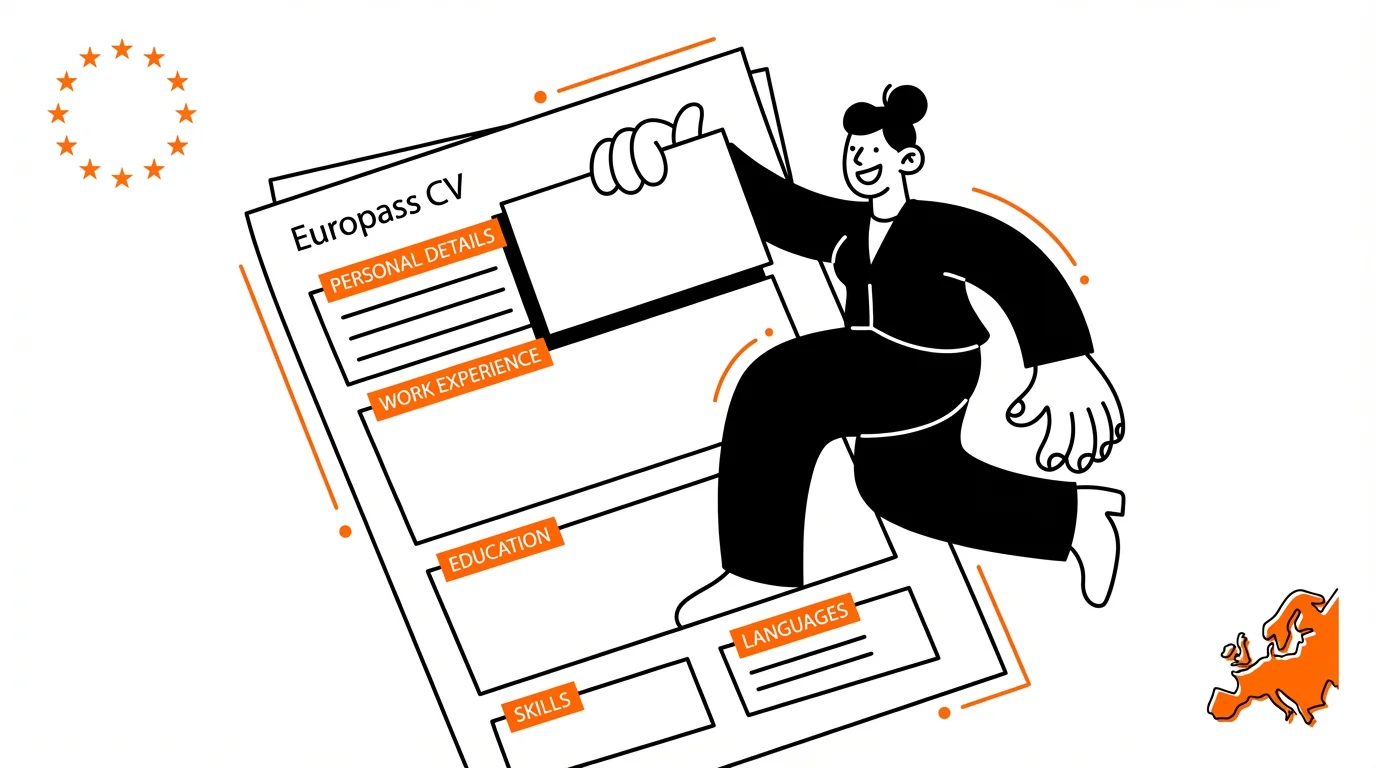
The Europass CV is the European Union's standardized CV format. It presents personal details, work experience, education, language skills and digital skills in a fixed order that employers and institutions across the EU recognize. You build it free at europass.europa.eu, generate as many tailored versions as you need from one profile, and export them as PDF.
Below you'll find a copy-paste Europass CV template, a complete filled-in example, what belongs in each section, and how to keep the format ATS-friendly.
Jump to:
- Europass CV template - the full skeleton, ready to copy and paste
- Europass CV example - a complete filled-in CV, plus strong and weak entries side by side
- Europass CV in English - when to write it in English and when not to
- What goes in each section - field by field, with what to leave out
- Is it ATS-friendly? - where the template parses badly and how to fix it
If you're applying for jobs, study programs, training, or volunteering in Europe, the Europass CV format is still one of the most recognized documents around. The upside is that recruiters and institutions already know how to read it. The downside is that if you just dump your history into the template, your CV can end up looking exactly like everyone else's.
The good news is that you do not need to reinvent the format to make it stronger. A better Europass CV usually comes down to sharper content, clearer results, and tailoring your wording to the role you actually want. The structure is given to you — what you write inside it is what determines whether you stand out.
What is a Europass CV?
A Europass CV is the European Union's standardized CV format, built to help candidates present their education, work experience, and skills in a way that is familiar across countries. The official Europass tools let you create a profile once and then generate one or more CV versions from it — which is especially useful if you're applying in more than one country or for more than one type of opportunity.
One big reason people still use Europass is consistency. The platform covers jobs, education, training, and volunteering, and lets you create, store, and share CVs in multiple languages. That makes it practical for cross-border applications, even if it is not the flashiest format available.
How to make a Europass CV (step by step)
Creating one is free and takes about 20–30 minutes the first time:
- Go to the official builder at europass.europa.eu and sign in or continue as a guest (an account lets you save and reuse your profile).
- Fill in your profile: personal details, work experience, education and training, language skills, and digital/other skills. Be complete here — this is your master record.
- Generate a CV from the profile. Choose which entries to include for this specific application — you don't have to include everything.
- Pick a template and language. Europass offers several layouts; the simpler ones are the most ATS-friendly.
- Export as PDF and review the result top to bottom before sending — check dates, titles, and that the content actually matches the role you're applying for.
Europass CV template (copy and paste)
The official builder generates the layout for you, but it helps to see the structure as plain text — especially if you want to draft offline first, or need an editable version in Word or Google Docs. Copy the skeleton below, fill it in, then either paste it into the Europass builder or keep it as a clean one-column document.
[FULL NAME]
[Job title you are targeting]

[Street, Postcode City, Country] | [+country code phone] | [email]
[LinkedIn or portfolio URL] | [Nationality — optional] | [Date of birth — optional]

ABOUT ME
[2–4 sentences: your role and years of experience, your strongest measurable
result, the languages you work in, and the type of role you are seeking.]

WORK EXPERIENCE
[Job title] — [Employer], [City, Country]        [MM/YYYY – MM/YYYY]
  • [Achievement with a number: what you improved, by how much, how]
  • [Achievement with scope: volume, budget, team size, markets, tools]
  • [Achievement with outcome: what changed because of your work]

[Job title] — [Employer], [City, Country]        [MM/YYYY – MM/YYYY]
  • [Achievement]
  • [Achievement]

EDUCATION AND TRAINING
[Degree or qualification] — [Institution], [City, Country]   [MM/YYYY – MM/YYYY]
  [EQF level if known] | [Thesis, specialisation or key subjects — optional]

LANGUAGE SKILLS
Mother tongue: [Language]
[Language] — Listening [A1–C2] | Reading [A1–C2] | Spoken production [A1–C2] |
             Spoken interaction [A1–C2] | Writing [A1–C2]

DIGITAL SKILLS
[Tools and platforms you actually use, grouped: e.g. SAP, Excel (advanced),
Power BI, SQL]

OTHER SKILLS
[Certifications, licences, volunteering, publications — only if relevant]
Two things to keep in mind when you use it. First, the section order above matches the official Europass order, so nothing will look unfamiliar to a recruiter. Second, if you rebuild this in Word, keep it in a single column with no tables, text boxes, headers or footers — those are the elements that most often scramble in parsing.
What goes in each Europass CV section
Every section has a job to do. This is what belongs in each one, and the mistake that most often weakens it.
| Section | What to put in it | Most common mistake |
|---|---|---|
| Personal details | Name, target job title, city and country, phone with country code, professional email, LinkedIn. | Full street address and date of birth when neither is required. |
| About me | 2–4 sentences: seniority, strongest quantified result, languages, the role you want. | Generic adjectives ("motivated team player") with no evidence behind them. |
| Work experience | Reverse-chronological roles, 3–5 achievement bullets each, with numbers. | Pasting the original job description instead of what you achieved. |
| Education and training | Degree, institution, dates, EQF level, plus courses relevant to the role. | Listing secondary school once you have a degree and work history. |
| Language skills | Mother tongue, then each language rated on the CEFR scale (A1–C2) per skill. | Inflating a level you cannot sustain in an interview held in that language. |
| Digital skills | Named tools and platforms you actually use, with proficiency where it matters. | "Microsoft Office" as a standalone skill — it tells a recruiter nothing. |
Europass CV example: what a strong entry looks like
The structure is fixed, so the difference between a weak and a strong Europass CV is the writing inside each section. Here's a realistic example of the two sections that matter most.
About me / personal statement
Logistics coordinator with 5 years of experience in cross-border e-commerce fulfilment across the DACH region. Reduced average delivery times by 18% by renegotiating carrier contracts and redesigning the returns workflow. Fluent in English and German (C1), currently seeking a supply chain role in an international team.
Work experience entry
Logistics Coordinator — Beispiel GmbH, Berlin (03/2021 – present)
- Coordinate daily fulfilment for 2,000+ orders across 6 EU markets using SAP and Sendcloud
- Reduced average delivery time from 4.4 to 3.6 days by switching regional carriers
- Cut return-processing backlog by 60% by introducing a triage workflow adopted by 3 other teams
Compare that to the typical Europass entry — "Responsible for logistics and deliveries. Worked with carriers and handled returns." — and you can see why the same format produces completely different results. The template is identical; the evidence is not.
A complete Europass CV example
Here is the same candidate as a full CV, so you can see how the sections read together. Note how every experience bullet carries a number, and how the language section is specific rather than aspirational.
MARTA KOWALCZYK
Supply Chain Coordinator

Berlin, Germany | +49 30 1234567 | marta.kowalczyk@email.com
linkedin.com/in/martakowalczyk

ABOUT ME
Logistics coordinator with 5 years of experience in cross-border e-commerce
fulfilment across the DACH region. Reduced average delivery times by 18% by
renegotiating carrier contracts and redesigning the returns workflow. Works in
English, German (C1) and Polish (native). Seeking a supply chain role in an
international team.

WORK EXPERIENCE
Logistics Coordinator — Beispiel GmbH, Berlin, Germany     03/2021 – present
  • Coordinate daily fulfilment for 2,000+ orders across 6 EU markets using
    SAP and Sendcloud
  • Reduced average delivery time from 4.4 to 3.6 days by switching regional
    carriers, saving EUR 74,000 in annual shipping spend
  • Cut the return-processing backlog by 60% by introducing a triage workflow
    later adopted by 3 other teams

Logistics Assistant — Przyklad Sp. z o.o., Krakow, Poland  09/2019 – 02/2021
  • Processed 400+ weekly outbound shipments and resolved customs
    documentation for 3 non-EU destinations
  • Built the warehouse's first stock-discrepancy report, reducing monthly
    write-offs by 22%

EDUCATION AND TRAINING
MSc International Logistics — Cracow University of Economics,
Krakow, Poland                                             10/2017 – 06/2019
  EQF level 7 | Thesis: last-mile delivery cost models in CEE e-commerce

BSc Management — Cracow University of Economics, Poland    10/2014 – 06/2017
  EQF level 6

LANGUAGE SKILLS
Mother tongue: Polish
English — Listening C1 | Reading C2 | Spoken production C1 |
          Spoken interaction C1 | Writing C1
German  — Listening C1 | Reading C1 | Spoken production B2 |
          Spoken interaction B2 | Writing B2

DIGITAL SKILLS
SAP MM/SD (advanced), Sendcloud, Excel (pivot tables, Power Query),
Power BI, SQL (basic)

OTHER SKILLS
IATA Dangerous Goods Regulations certificate (2023, valid to 2026)
Category B driving licence
Swap in your own roles and numbers and you have a working draft. The part that takes real effort is not the layout — it is turning each responsibility into a result with a number attached.
Europass CV in English: when to use it and how to write it
Europass can generate the same profile in any EU language, which raises an obvious question: which one should you actually send? The rule is simple — write in the language of the job advert. If the advert is in English, or the role sits in an EU institution or an international team, English is right. If the advert is in the local language and the role is local-facing, write it in that language, even if your English is stronger.
A few things worth getting right in an English Europass CV specifically:
- Use one English variant consistently. British "organised, programme, centre" or American "organized, program, center" — either is fine, mixing them is not.
- Write dates unambiguously. "03/2021 – present" reads the same everywhere; "03/04/2021" does not.
- Translate qualifications, don't transliterate them. Give the local name plus the EQF level, so a recruiter in another country can place it.
- Keep CEFR labels, not adjectives. "German C1" is verifiable; "good German" is not.
- Localise the job title. Use the title the advert uses, not a literal translation of your internal one — that is also what an ATS is matching against.
If you keep one master profile in Europass, you can maintain an English version and a local-language version side by side and generate whichever the application needs.
Is the Europass CV ATS-friendly?
Yes — the Europass CV is generally ATS-friendly. It uses standard section headings, a predictable order, and a clean single-column structure, which is exactly what applicant tracking systems parse most reliably. The format is rarely the reason an application gets filtered out.
What does cause problems is everything layered on top of it:
- The decorative templates. Europass offers several designs; the ones with sidebars, coloured columns or icon rows are harder to parse than the plain layout. When in doubt, pick the simplest one.
- The photo field. An image carries no parsable text, and in anonymized-screening setups it can work against you. Include it only where local convention expects it.
- Skill-level graphics. Bars and dots representing proficiency read as nothing at all to a parser. CEFR letters and named tools do read.
- Untailored wording. This is the real one. ATS scoring compares your wording to the job advert, and a Europass CV sent unchanged to twenty employers matches none of them well.
The fastest way to check where you stand is to run the exported PDF through a parser before you send it. Our free ATS resume checker scores your CV on structure, keywords and readability and tells you which sections a parser struggles with — useful for a Europass export precisely because the format looks fine to a human even when a template choice has broken it.
Europass CV vs a standard CV
"EU CV format" and "European CV format" usually mean Europass, but they are not the only option in Europe. Here is how the two compare on the things that actually decide an application.
| Europass CV | Standard (self-formatted) CV | |
|---|---|---|
| Structure | Fixed sections in a fixed order | You decide the order and emphasis |
| Recognition | Instantly familiar across the EU | Depends on local convention |
| Length | Tends to grow — 2–3 pages is common | Easier to keep to 1–2 pages |
| Differentiation | Low — everyone's looks the same | High — layout can support your story |
| Language skills | Dedicated CEFR-rated section | Usually a line in a skills list |
| ATS parsing | Reliable on the plain templates | Reliable if you keep one column |
| Best for | EU institutions, universities, Erasmus, mobility schemes, and any employer that asks for it | Private-sector roles, competitive markets, and applications outside Europe |
The short version: use Europass when it is requested or when a recognizable standard format helps you, and a self-formatted CV when you are competing on how well your story is told. For a fuller breakdown of the two document types, see our CV vs resume guide.
When a Europass CV makes sense
A Europass CV makes the most sense when an employer or institution expects it, or when you're applying in a context where a standardized European format is helpful. That includes EU-wide job applications, universities, training programs, mobility schemes like Erasmus, and roles where a familiar, structured document makes candidate comparison easier.
That does not mean Europass is automatically the best option for every application everywhere. In some private-sector or highly competitive roles, a more tailored local format may feel more natural to recruiters. But if the employer asks for Europass — or if you're applying across European markets and want a format people instantly recognize — it's a solid choice.
The biggest Europass CV mistake: treating the template as the strategy
A lot of people assume the template itself will do the work. It won't. Europass gives you the structure, but your wording is what determines whether the CV feels generic or convincing. A recruiter is still looking for the same things they look for in any strong resume: relevant skills, clear impact, and proof that you can do the job.
So the real goal is simple: keep the Europass structure recognizable, but make the content sharper than the average Europass CV. That means less "responsible for" and more measurable outcomes, less copy-paste and more role-specific language, and less filler in the skills section. Eye-tracking research consistently shows that recruiters scan documents in seconds — which means vague, templated language gets skipped, not read.
How to make your Europass CV stand out
1. Build a complete base profile before you start tailoring
The official Europass tools are built around the idea of creating a profile first, then generating as many CVs as you need from that profile. That's the smart way to do it: create one solid master version with all your education, roles, skills, and languages, then trim and adapt for each application instead of rewriting your life story every time.
This is also where it helps to think like a recruiter, not like an archivist. Your master profile can be comprehensive, but the final CV should only include the parts that strengthen your case for that specific role. More information is not always more persuasive.
2. Keep the format familiar, but make the content stronger
The value of Europass is that people already know the structure, so don't fight the format too hard. Use the standard sections, keep the layout clean, and focus your effort on what goes inside each section rather than trying to redesign the whole thing.
Inside your work experience section, avoid pasting job descriptions. Instead, turn each entry into evidence. Show what you improved, built, led, reduced, grew, or delivered. According to Harvard's resume guidance, specific, active, fact-based language is what helps fast-scanning recruiters understand your value quickly.
3. Replace duties with achievements
This is the easiest upgrade you can make. "Managed projects" is weak. "Managed 12 client projects and improved on-time delivery from 78% to 95%" is much better. "Worked with social media" is vague. "Increased organic engagement by 34% through a new content calendar and faster reply workflow" actually says something.
Europass can sometimes encourage people to become too descriptive and not results-focused enough. Don't let that happen. If you can quantify it, quantify it. If you can name the tool, method, market, or outcome, name it. Clear numbers and clear outcomes are what make the content memorable.
4. Tailor the Europass CV to the job, not just to your history
This is where most candidates lose points. They create one Europass CV, export it once, and send it everywhere. That feels efficient, but it usually hurts your chances because both recruiters and applicant tracking systems respond better when your CV reflects the language of the job description. See our guide on ATS resume optimization for how ATS screening actually works.
A better approach: keep the Europass format, but tailor the summary, skills, and the top bullets in your most relevant roles. If a job ad keeps repeating terms like "stakeholder management," "SQL," "customer onboarding," or "regulatory compliance," and you actually have those skills, your CV should say so in that language. That is one of the fastest ways to look like a closer match.
5. Use the language section properly
One reason Europass is popular across Europe is that language skills matter a lot in cross-border applications. The format gives languages a visible place, which is helpful if multilingual communication is relevant to the role. If you list languages, be honest and specific about your level rather than inflating it.
This is especially useful if you are applying for roles involving customer support, mobility, education, public administration, or any environment where working across countries is normal. In those cases, your language section is not just "nice to have" detail — it can be a real differentiator.
6. Keep it simple enough for ATS and human readers
Even though Europass is standardized, the basic resume rules still apply: clarity beats decoration. ATS-friendly CVs work best with straightforward structure, clear headings, and readable formatting — not complicated layouts, tables, or visual tricks that can scramble information in parsing. That's another reason not to over-customize the Europass design. A clean CV is easier for software to parse and easier for a recruiter to skim.
7. Proofread like it actually matters, because it does
Typos, inconsistent dates, weird capitalization, and copy-paste leftovers make even strong candidates look careless. Before you send your Europass CV anywhere, check the basics: dates, job titles, company names, grammar, and whether the final version still sounds like it was written for the actual role.
A good last step is to read the document top to bottom and ask one simple question: "Would a recruiter understand my fit for this job in under 10 seconds?" If the answer is "not really," the issue usually isn't the Europass format itself — it's that the content still needs tightening.
Common Europass CV mistakes to avoid
Overloading the CV with irrelevant history. Just because Europass gives you room to add information doesn't mean every internship, course, or old part-time job deserves equal space. Keep the focus on what supports the application in front of you.
Vague language. Phrases like "good communication skills," "team player," or "responsible for various tasks" do almost nothing on their own. Replace them with evidence, context, and outcomes whenever possible.
Sending the same Europass CV to every employer. One-size-fits-all CVs tend to perform worse because they are weaker on both relevance and keyword match. Even small changes to your summary, skills, and top bullets can make a meaningful difference to how well your application matches the vacancy. Check our top 10 resume mistakes guide for more common errors that cost candidates interviews.
How ApplyMate can help with a Europass CV
Europass is good at giving you a recognized structure. What it does not do for you is decide which skills to emphasize, which keywords to mirror from the job ad, or how to rewrite weak bullets into stronger ones. That part is still on you.
That's where ApplyMate fits in. Instead of replacing Europass, it helps you improve the content that goes inside it: tailored summaries, better bullet points, stronger keyword alignment, and more ATS-friendly phrasing. Then you move that polished content into the official Europass builder and export a version that is both recognizable and more competitive.
The workflow is straightforward: use ApplyMate's resume tailoring tool to match your content to the job description, then paste the improved text back into your Europass layout before exporting the final version.
Related Resources
If you found this guide useful, these tools and articles can help with the next steps:
- Free ATS Resume Checker — score your CV against ATS criteria before you send it
- ATS Resume Optimization Tips — how to get past automated screening
- ATS Resume Template — a free ATS-safe template if you want an alternative to Europass
- Top 10 Resume Mistakes — common errors that cost candidates interviews
- LinkedIn Profile Checker — optimize your LinkedIn to complement your CV
- Resume With or Without Photo? — when the Europass photo field helps or hurts
- Writing an "About Me" Section — how to write a strong profile section for your CV
- CV vs Resume: What's the Difference? — when the long-form CV is required and when a one-page resume wins
Frequently Asked Questions
How do I create a Europass CV?
Go to europass.europa.eu, create a free account (or continue as a guest), fill in your profile — personal details, work experience, education, languages, and skills — then generate a CV from the profile, pick a template, and export it as a PDF. The profile is reusable, so you can generate tailored versions for each application.
Is the Europass CV free?
Yes. The Europass CV builder is a free official service from the European Union. Creating a profile, generating CVs in multiple languages, and exporting PDFs all cost nothing.
What is the Europass CV format?
The Europass CV is the European Union's standardized CV format, designed to present education, work experience, skills, and language proficiency in a consistent way that is recognized across EU countries. You create it through the official Europass platform, which lets you build a profile once and generate multiple tailored CV versions from it.
Can I customize a Europass CV?
Yes — and you should. The official Europass tools let you choose what information to include, reorder sections, and select a design. More importantly, you should customize the content: tailor your summary and bullet points to each job, mirror the language of the job description, and cut anything that doesn't strengthen your case for that specific role.
Is Europass CV only for jobs in Europe?
It is most useful in Europe, where the format is best known and most familiar to employers and institutions. Outside Europe, local resume conventions may be more appropriate unless the employer specifically requests Europass. If you're applying internationally, check what format is standard in that country before defaulting to Europass.
Should I use the same Europass CV for every job?
No. Keep one solid base profile, then tailor the final CV to each role. Even small changes to your summary, skills list, and top bullet points can significantly improve how closely your application matches the vacancy — for both human recruiters and ATS systems.
Is there a Europass CV template in Word?
The official platform exports to PDF and to the Europass XML/JSON format, not to Word. If you need an editable .docx, copy the plain-text structure from the template section above into a clean one-column Word document. Avoid tables, text boxes, headers and footers — those are what usually break ATS parsing.
How long should a Europass CV be?
Two pages for most candidates, three at most for senior or academic profiles. Europass will happily generate five pages if you fill in every field, but length is not a strength signal. Include only the entries that support the specific role, and delete the rest from that generated version.
Do I need a photo on a Europass CV?
It is optional and depends on the country. Photos are still common in Germany, Austria, Spain, Italy and much of Central and Eastern Europe, and discouraged in the UK, Ireland, the Netherlands and any anonymized-screening process. When the employer gives no guidance, leaving it out is the safer default — our resume photo guide covers the country-by-country picture.
Should I write my Europass CV in English?
Write it in the language of the job advert. English is right when the advert is in English, or the role is at an EU institution or in an international team. If the advert is in the local language and the role is local-facing, write it in that language. Europass generates the same profile in multiple languages, so you can keep both versions from one profile.
Does Europass CV work with ATS systems?
Generally yes — the Europass format uses a clean, structured layout that ATS systems can parse reliably, which is one of its strengths. That said, the keywords and phrasing in your content still need to match the job description for ATS scoring to work in your favour. The format is ATS-compatible; the content still needs to be tailored.
Conclusion
A Europass CV does not need to be flashy to work well. It just needs to be clear, relevant, and tailored. Keep the structure familiar, write achievement-focused bullets, and align your language with the role — and you can absolutely make a Europass CV stand out.
If the content-writing part is slowing you down, ApplyMate can do the heavy lifting: tailored summaries, stronger bullet points, better keyword alignment. Then paste the result back into your Europass builder and export. No subscription required.