ATS-Friendly Cover Letter Template (Free Word and Google Docs Copy)
 , Co-founder of ApplyMate
·
Updated
, Co-founder of ApplyMate
·
Updated

An ATS-friendly cover letter is one an applicant tracking system can parse cleanly and that mirrors the language of the job description: a single-column layout, a standard font, no tables or text boxes, and the posting's key skills woven into real sentences. The template below is exactly that, and it is free - copy it, download it as a Word file, or open it in Google Docs.
Most cover letter advice ignores the parsing half entirely. People agonize over the opening line, then submit a beautifully designed two-column PDF that arrives as word salad. This page gives you the template first, then the format rules behind it, five filled-in examples, and what changes if you are applying outside the US.
Five rules carry most of an ATS-friendly cover letter:
- One column, standard font. Contact details in the body of the letter, never in a header or footer.
- 250–400 words. Three or four paragraphs, one page.
- The exact job title from the posting in your opening sentence.
- Three to five of the posting's repeated requirements, worked into claims that carry numbers.
- PDF or .docx, whichever the application asks for - both parse fine in modern systems.
The ATS-friendly cover letter template
Here is the template in full. It parses cleanly, runs about 300 words once filled in, and forces the tailoring that both the software and the recruiter reward. Everything in square brackets is yours to replace.
[Your Full Name]

[City, State ZIP] | [Phone] | [Email] | [LinkedIn URL]

[Month Day, Year]

Dear [Hiring Manager's name, or "Hiring Team" if the posting does not name one],

I am applying for the [exact job title as written in the posting] role at [Company]. I am a [your current title] with [X] years in [field], and [one sentence naming the posting's single hardest requirement and the evidence you have for it].

In my current role at [Current Company], I [specific accomplishment that uses two or three terms from the posting, with a number attached]. Before that, I [second accomplishment covering a different requirement from the posting, also with a number]. Both map directly to [requirement quoted from the posting].

[Optional, one sentence: something specific about this employer - a product, a market, a recent change - that explains why this job rather than any job. Delete this line rather than filling it with a compliment.]

I would welcome the chance to talk about [team, product or goal named in the posting]. Thank you for your time.

Sincerely,

[Your Full Name]
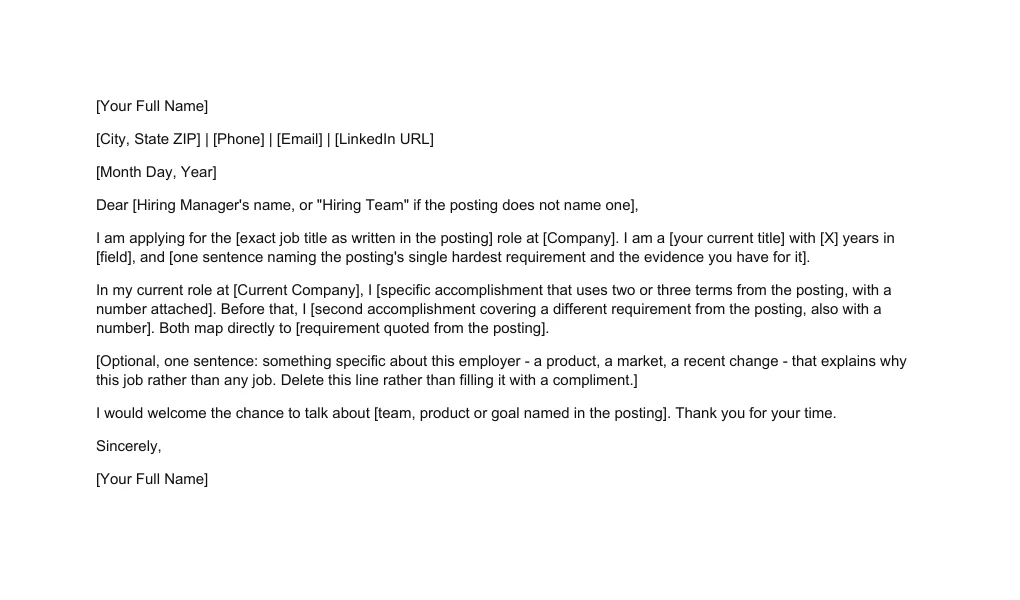
The Word file is generated from the text above, so the two are always the same letter. It is Calibri 11pt on US Letter (8.5 x 11 in) with 1-inch margins, single column, with no tables, text boxes, images, headers or footers - the same rules this article recommends.
How to fill in the template in five minutes
The template is deliberately empty where the tailoring happens. Work through it in this order and the letter writes itself from the posting:
- Name the role exactly. Replace [exact job title as written in the posting] with the title exactly as the posting writes it, including seniority. Write "Senior Customer Success Manager", not "client success lead".
- Pull the repeated requirements. Read the posting and list the three to five skills, tools or responsibilities it mentions more than once. Those repetitions are what the employer screens on.
- Attach a number to each claim. Fill the two middle-paragraph placeholders with accomplishments that use those terms and carry a figure — a percentage, an amount, a headcount, a timespan.
- Cut or fill the company line. Either write one specific sentence about this employer, or delete the optional line entirely. A generic compliment is worse than no sentence.
- Check the length and the file. Confirm the filled letter runs 250–400 words on one page, then save as PDF or .docx depending on what the application asks for.
If step 2 is the part you get stuck on, the job description keyword finder pulls the screened-for terms out of a posting for you.
If you would rather not fill it in at all, the free cover letter generator does the same five steps from your resume and the posting: upload the file, paste the ad, and it writes the letter from what your own document evidences. The first one is free and complete.
Do ATS systems actually read cover letters?
They store it and make it searchable — but no major vendor documents software that scores or rejects on it. Workday, Greenhouse, Lever, Taleo and iCIMS all parse the cover letter and keep it with the rest of the application. Lever's own help documentation says its candidate search indexes any parseable content attached to a candidate profile, so a recruiter searching for a skill can surface your letter alongside your resume.
That distinction matters, because the internet is full of advice implying a cover letter has a match score to beat. None of these vendors publishes one. What the letter has to survive is being found by a keyword search and then read by a person — which is why the two disciplines below are formatting that parses and language that matches the posting, not keyword density. For how the resume side of screening actually works, including where genuine automatic rejection does happen, see our guide to ATS resume optimization.
ATS cover letter format rules that actually matter
Parsers are better than they were five years ago, but they still fail on the same handful of design choices. An ATS-friendly cover letter format follows these rules:
- Single column, top to bottom. No sidebars, no two-column layouts — parsers read across and merge columns into nonsense.
- No tables or text boxes. Content inside them is frequently dropped entirely.
- Contact details in the body, not the header/footer. Many parsers skip header and footer regions.
- Standard fonts (Arial, Calibri, Georgia, Times) at 10.5–12pt. Decorative fonts can break character recognition in scanned formats.
- No images, icons, or graphics. They add nothing machine-readable and bloat the file.
- PDF or .docx, whichever the application requests. If it doesn't say, PDF preserves your formatting and parses fine in modern systems.
- 250–400 words. Three to four short paragraphs. Recruiters skim; parsers don't reward length.
Filled-in example 1: a marketing manager applying to a demand-gen role
Here is the template filled in against a posting that repeats "demand generation", "HubSpot" and "pipeline growth". Notice that every keyword is attached to a number, and none of them appears as a list.
Priya Raghavan
Austin, TX 78704 | (512) 555-0143 | priya.raghavan@example.com | linkedin.com/in/priyaraghavan
March 4, 2026
Dear Hiring Team,
I am applying for the Demand Generation Manager role at Northwind Software. I am a marketing manager with six years in B2B SaaS, and I have run demand generation programs that carried a pipeline number rather than a lead number. I have worked in HubSpot for five of those six years, including two migrations into it.
In my current role at Northbeam, I own demand generation across paid and lifecycle channels, running all campaign operations in HubSpot. Over the last year my campaigns contributed 38% of new pipeline — $2.1M in qualified opportunities — and cut cost per MQL by a quarter. Before that, I built the outbound program at a 40-person startup from zero to its first $500K in sourced pipeline, and set up the HubSpot attribution reporting the team still runs on. The lifecycle half of that work is what I would bring first: I rebuilt our nurture tracks around product usage rather than send date, which took MQL-to-SQL conversion from 18% to 29% in two quarters and is now how the whole lifecycle program is segmented.
Northwind's move into mid-market is the part that interests me; that transition is where the demand-gen mix has to change most, and it is the work I have done twice.
I would welcome the chance to talk about how I can contribute to pipeline growth on your marketing team. Thank you for your time.
Sincerely,
Priya Raghavan
Three keywords, all load-bearing, all attached to figures. That letter scores with a parser and persuades a human, which is the whole game.
Filled-in example 2: a career changer with no direct experience
The harder case is when your last job title does not match the one you are applying for. The template does not change; what changes is that the evidence comes from adjacent work rather than the same work.
Daniel Okafor
Manchester, NH 03101 | (603) 555-0198 | d.okafor@example.com | linkedin.com/in/danielokafor
March 4, 2026
Dear Ms. Alvarez,
I am applying for the Junior Data Analyst role at Barrowfield Health. I have spent four years as a pharmacy operations coordinator, and the part of that job I did most was the part this role is made of: pulling, cleaning and reporting on dispensing data in SQL and Excel. The three tools this posting lists are the three I already work in every day.
At Riverside Pharmacy Group I built the weekly dispensing report that eight branch managers now use, replacing a manual process that took a colleague most of a day. I wrote the SQL behind it, and the reporting cut stock-out incidents by 31% over two quarters because the branches could finally see demand a week ahead. I also reconciled the controlled-substance register every month, which is where I learned that most of an analyst's week goes on making the data trustworthy rather than on the analysis itself. I completed the Google Data Analytics certificate last year, where the capstone was a Tableau dashboard on prescribing patterns across a year of anonymised claims data.
Barrowfield's work on medication adherence is the reason I am applying here specifically rather than to analyst roles generally — it is the same problem I have been reporting on from the pharmacy side.
I would welcome the chance to talk about how I can contribute to the analytics team. Thank you for your time.
Sincerely,
Daniel Okafor
No claim here is invented, and the letter never apologizes for the change of field. It names the overlap and quantifies it, which is the only thing that answers "why you" for a career changer.
The three examples below are situations where the application itself changes the letter. If your problem is the experience rather than the format - a first job, a break in your history, or a field next to the one you are applying to - we have four complete letters for having no directly relevant experience, written the same way these are.
Filled-in example 3: pasting into the application's own text box
Plenty of applicant tracking systems do not take a file for the cover letter at all. They give you a plain-text box, and everything you formatted is gone the moment you paste. The letter has to survive that, so this version carries no contact block (the form already has your details), no bullets, no tabs and no curly quotes - just paragraphs separated by a blank line.
Dear Hiring Team,
I am applying for the Warehouse Operations Supervisor role at Kessler Logistics. I supervise a 22-person shift at a 400,000 square foot distribution center, and I have run the warehouse management system cutover this posting describes needing.
At Fairmount Distribution I took pick accuracy from 96.4% to 99.1% over eight months, by rebuilding the cycle count schedule and retraining the second shift on the handheld workflow. I also ran the floor-side migration to a new warehouse management system across two buildings, which meant writing the standard operating procedures and training 60 associates in six weeks with no missed outbound days. Safety came with it: we closed last year at 41 days without a recordable incident, the longest run the site has had.
Before Fairmount I spent three years as a lead picker and then as an inventory control clerk on the same floor, so I have done most of the jobs I would be supervising. That is also where the cycle count work came from: I was the one recounting the locations the system had wrong, on a floor of about 9,000 pick faces.
Kessler's move to same-day regional fulfillment is the reason I am applying here rather than to supervisor roles generally. That change lives or dies on pick accuracy, which is the number I have spent four years moving.
I would welcome the chance to talk about the night shift opening. Thank you for your time.
Sincerely,
Marcus Bell
Two things to check before you paste. Type the apostrophes and hyphens in a plain editor rather than in Word, which silently converts them into characters some older systems render as question marks. And put a blank line between paragraphs, because many of these boxes strip the indentation that would otherwise be the only thing separating them.
Filled-in example 4: stepping up to a title you have not held
The posting asks for a manager and your title says senior engineer. The template does not change here either; what changes is that the opening sentence has to name the gap and then close it, because a recruiter scanning your resume will see the title before they see anything else.
Tomas Delgado
Denver, CO 80205 | (303) 555-0176 | t.delgado@example.com | linkedin.com/in/tomasdelgado
March 4, 2026
Dear Ms. Okonjo,
I am applying for the Engineering Manager role at Halcyon Systems. My title is senior software engineer, and for the last two years I have done most of the manager's job alongside it: I lead a four-person team, run our hiring loop, and own the on-call rotation for payments.
At Ledgerwise I planned and staffed the re-architecture of our payments service across three quarters, and it took p99 latency from 840ms to 210ms without a customer-facing incident. I wrote the interview rubric the team hires on and have run 40 loops with it, which moved our offer-accept rate from just under half to 71%. The two engineers I have mentored longest were both promoted last cycle, and I ran their reviews in everything but name.
What I have not done is carry the headcount or the budget, and I would rather say so than imply otherwise. I have written the roadmap for our half of the platform for three cycles running, and I have twice made the call to stop a project that was not going to land, so the judgement the title formalises is not new to me. Halcyon's move to real-time settlement is the work I want to be doing, and it is close enough to the migration I just finished that I would be useful in the first month rather than the sixth.
I would welcome the chance to talk about how I would run the payments team. Thank you for your time.
Sincerely,
Tomas Delgado
Naming the gap is what makes the rest of it credible. A letter that quietly writes around the missing title reads as though it hopes nobody checks, and the one thing a hiring manager for this role definitely does is check.
Filled-in example 5: the short version, when the cover letter is optional
When the application marks the letter optional, the choice is not between a long letter and no letter. It is between a short specific one and a long generic one, and the short specific one wins. This is the only example on this page deliberately under the 250-word floor, because a letter nobody asked for earns its length one sentence at a time.
Hannah Whitfield
Providence, RI 02906 | (401) 555-0122 | h.whitfield@example.com | linkedin.com/in/hannahwhitfield
March 4, 2026
Dear Hiring Team,
I am applying for the Registered Nurse, Medical-Surgical role at St. Brendan's Regional. I am an RN with five years on a 32-bed med-surg unit, and I hold the ACLS and PALS certifications the posting lists as required.
At Cedar Ridge Medical Center I precept new graduate nurses and chair our unit's falls-reduction committee, which brought falls with injury down 44% over two years. I carry a five-patient assignment on nights, which is the acuity the posting describes.
I am applying to St. Brendan's specifically because of the Magnet re-designation work; those are the standards I have been documenting to on my own unit.
Thank you for your time.
Sincerely,
Hannah Whitfield
Everything optional is gone: no explanation of why the candidate is looking, no restatement of the resume, no closing paragraph asking for an interview twice. What is left is a claim, two pieces of evidence with a number on one of them, and a reason for this employer.
US cover letter conventions, and what changes elsewhere
The template above follows US conventions, which are the strictest about what you leave out. A US cover letter carries no photo, no date of birth, no marital status and no nationality — including any of them is a discrimination-law problem for the employer, and some applicant tracking systems are configured to strip or flag them. Elsewhere the expectations differ:
| Element | United States | United Kingdom | Continental Europe | Australia |
|---|---|---|---|---|
| Photo | Never | Never | Common in DE, AT, CH; avoid elsewhere | Never |
| Date of birth | Never | Never | Still expected in parts of DE and AT | Never |
| Marital status | Never | Never | Occasionally seen; safe to omit | Never |
| Your mailing address | City, state and ZIP is enough | City and postcode is enough | Often full address | City and state is enough |
| Employer address block | Optional; common in formal sectors | Optional | Usually expected | Optional |
| Date line | March 4, 2026 | 4 March 2026 | 4 March 2026 | 4 March 2026 |
| Page size | US Letter | A4 | A4 | A4 |
| Length | 250–400 words, one page | 250–400 words, one page | One page; DE tolerates denser | 250–400 words, one page |
The downloadable file is US Letter. If you are applying in the UK, Europe or Australia, change the page size to A4 before you send it — in Word that is Layout → Size → A4, and in Google Docs it is File → Page setup → A4. Nothing else in the template needs to change.
How to use keywords without sounding robotic
Keywords are where cover letters quietly win or lose. The method is the same one that works for resumes:
- Mirror the job title exactly. If the posting says "Senior Customer Success Manager," your first paragraph should use that phrase — not "client success lead."
- Pull the 3–5 most repeated requirements from the posting — skills, tools, certifications, domains. If "stakeholder management" appears three times, it belongs in your letter.
- Use them inside real claims. "At Acme I owned stakeholder management for 12 enterprise accounts" beats a list of disembodied skills every time — for the parser and the person.
- Match the noun forms. Write the term the way the posting writes it ("project management," not just "managed projects") at least once.
What not to do: paste a keyword block, repeat a term in every sentence, or claim skills you don't have to chase a match score. Recruiters read these letters all day and spot stuffing in seconds.
Common ATS cover letter mistakes
- Reusing one letter everywhere. An untailored letter has near-zero keyword overlap with any specific posting — worse than no letter where it's optional.
- Fancy templates. Columns, colored sidebars, and headshots are the same parsing hazards that sink resumes — our top 10 resume mistakes guide covers the overlap.
- Repeating your resume. The letter should expand your two or three most relevant claims, not re-list your history.
- Burying the role. Name the exact position in the first sentence — applications get processed in bulk, and ambiguity costs you.
- Sending it with an unchecked resume. The letter is the supporting act. Run your resume through the free ATS resume checker first.
How this template was built
The format rules on this page come from the parsing documentation and behaviour of the applicant tracking systems named above — Workday, Greenhouse, Lever, Taleo and iCIMS — last re-checked in September 2026. Where systems disagree, the template follows the stricter one, which is why contact details sit in the body rather than a header.
The Word file is generated by this site from the same text shown on the page, not hand-made and uploaded, so the two cannot drift apart. Before it is served it is parsed back with the same document reader ApplyMate runs on every uploaded resume, and the test that proves every line survives that round trip runs in our test suite.
Related resources
- Free ATS resume checker — score your resume before you apply
- ATS resume template — an ATS-safe resume format to pair with your letter
- Job description keyword finder — pull the screened-for terms out of any posting
- ATS keywords list — how to build one from a single job ad
- Free cover letter generator — writes the letter from your resume and the posting, first one free
- The 10 best AI cover letter generators — if you would rather have one written than fill this template in
- Cover letter with no experience — four complete letters for a first job, a career change, a break, and an adjacent field
Frequently Asked Questions
Is there a free ATS-friendly cover letter template?
Yes. The template on this page is free, needs no signup, and comes three ways: copy it as text, download it as a Word .docx, or open it in Google Docs. It is a single-column letter in Calibri 11pt on US Letter with one-inch margins, which is the format applicant tracking systems parse most reliably.
Can you provide an example of an ATS-friendly cover letter?
Yes - there are five complete ones on this page, all filled in from the same template: a marketing manager who fits the posting directly, a career changer moving into data analysis, a letter pasted into an application's plain-text box, someone stepping up to a first management title, and a short version for when the cover letter field is marked optional. Four run about 250 words and the short one runs 127. Every keyword in them is attached to something the writer actually did, which is the only part that has to be true of yours too.
Do ATS systems actually read cover letters?
They store it and make it searchable, but no major vendor documents software that scores or rejects on it. Workday, Greenhouse, Lever, Taleo and iCIMS all parse and keep the cover letter with the rest of the application, and Lever's own documentation says its candidate search indexes any parseable content attached to a candidate profile - so a recruiter searching for a skill can surface your letter. What none of them publish is a cover letter score. Write it to be found and read, not to beat a filter.
What format should an ATS-friendly cover letter use?
A single-column layout in a standard font, saved as PDF or .docx depending on what the application asks for. No text boxes, tables, columns, images, or contact details hidden in a header or footer - parsers routinely scramble or drop content placed in those elements. Keep it to 250-400 words.
Should I put keywords from the job description in my cover letter?
Yes, but inside real sentences. Mirror the job title exactly as the posting writes it, and work three to five of its most repeated skills and requirements into specific claims about what you have done. Do not paste a keyword list; recruiters recognize stuffing instantly, and it wins nothing with the parser either.
How long should an ATS-friendly cover letter be?
250 to 400 words, in three or four short paragraphs, on one page. Length is not what a parser rewards and it is not what a recruiter has time for. Four of the five filled-in examples on this page run about 250 words, which is enough for an opening claim, two pieces of evidence and a close; the fifth runs 127, for the case where the application marks the cover letter optional and a short specific letter beats a long generic one.
Is a cover letter still necessary in 2026?
When the application asks for one, yes - skipping a requested cover letter filters you out at many companies before a person sees the application. When it is optional, a short tailored letter still helps for career changes, employment gaps and competitive roles, because it is the one place you can explain fit in your own words.
The short version
An ATS-friendly cover letter comes down to two disciplines: a clean single-column format any parser can read, and the job posting's own language woven into specific, quantified claims. The template above handles the first for you. The second is the fifteen minutes you spend on the posting.
If filling it in for every application is the bottleneck, our cover letter generator writes one from your resume in about a minute, and ApplyMate writes one with each tailored resume — matched to the job description, formatted for ATS, at no extra cost.